
Is Indoor Cycling a Full-Body Workout?
When most people picture an indoor cycling class, they picture legs. Legs burning, legs pushing, legs carrying you through a 45-minute ride that leaves you wondering why you thought this was a good idea. And while your lower body is absolutely doing the work, calling indoor cycling a leg workout does it a significant disservice. A well-programmed cycling class is a full-body workout—one that moves through your core, your upper body, and your cardiovascular system in a way that other cardio formats simply don’t. Here’s what’s actually happening in that room from the first pedal stroke to the last rep.
Table of Contents
How Indoor Cycling Works Your Lower Body
It makes sense that this is where most people’s attention goes, since the lower body is the engine of every cycling class, and it’s working from the moment the music starts.
Your quads are the primary drivers, firing every time you push the pedal down. But the pull phase—drawing the pedal back up through the bottom of the stroke—activates your hamstrings in a way that most cardio formats don’t. Your glutes engage most deeply during climbs, when resistance is high, and you’re driving through each stroke with intention. Your calves stabilize the entire movement throughout.
What makes indoor cycling particularly effective is how much the lower body emphasis shifts depending on how the class is programmed. Seated sprints at low resistance challenge your cardiovascular system and fast-twitch muscle fibers. Standing climbs at high resistance are closer to a strength exercise, as your glutes and hamstrings are working against load in a way that builds real muscular endurance over time. A well-programmed class moves through both, which is part of why the lower-body fatigue you feel as you walk out is so intense.
The other thing worth knowing: because cycling is low-impact, all of that lower-body work happens without the joint stress that running or jumping-based formats carry. Your heart rate climbs, your muscles work hard, and your knees and hips stay out of it.
Key Takeaways
- Your lower body is the engine of every cycling class. Quads, hamstrings, glutes, and calves are all engaged — and which muscles work hardest shifts depending on how the class is programmed.
- Seated sprints and standing climbs train different things. Sprints challenge your cardiovascular system and fast-twitch fibers. Climbs build real muscular endurance in your glutes and hamstrings against load.
- All of that work happens without joint stress. Because cycling is low-impact, your heart rate climbs and your muscles work hard while your knees and hips stay out of it.
Your Core Works the Entire Time
This is the part of indoor cycling that surprises most first-timers, and it’s one of the biggest reasons the workout earns its full-body reputation.
From the moment you clip in and find your position on the bike, your core is engaged. Maintaining an upright, stable riding posture requires constant activation of your deep abdominal muscles, your obliques, and the muscles along your spine. It’s not as dramatic or obvious as a crunch, but it’s continuous, and that continuous tension over 45 minutes adds up in a way that isolated core work rarely does.
The demand increases significantly when you come out of the saddle. Standing climbs and jumps remove the seat as a point of support, which means your core has to work harder to keep you stable over the bike. Your upper and lower body are pulling in different directions, and your midsection is what holds it all together. Done consistently, this kind of functional core engagement builds the kind of stability that carries over into everything else you do—other workouts, how you carry yourself, how your back feels at the end of a long day.
It’s also worth noting that core engagement in cycling is largely self-governed. An instructor can cue it, but you have to consciously activate it, especially when the lower body work gets hard and your instinct is to collapse into the handlebars. Learning to hold your posture through the difficult intervals is one of the key skills indoor cycling classes build (it’s also one of the more rewarding ones).
Key Takeaways
- Core engagement in cycling is continuous, not isolated. Maintaining a stable riding posture activates your deep abdominals, obliques, and spinal muscles for the duration of class.
- Standing climbs and jumps raise the demand significantly. Without the seat as a support point, your core has to work harder to hold you stable over the bike.
- It's largely self-governed. An instructor can cue it, but you have to consciously activate it — especially when the lower body work gets hard and the instinct is to collapse into the handlebars.
The Upper Body Segment
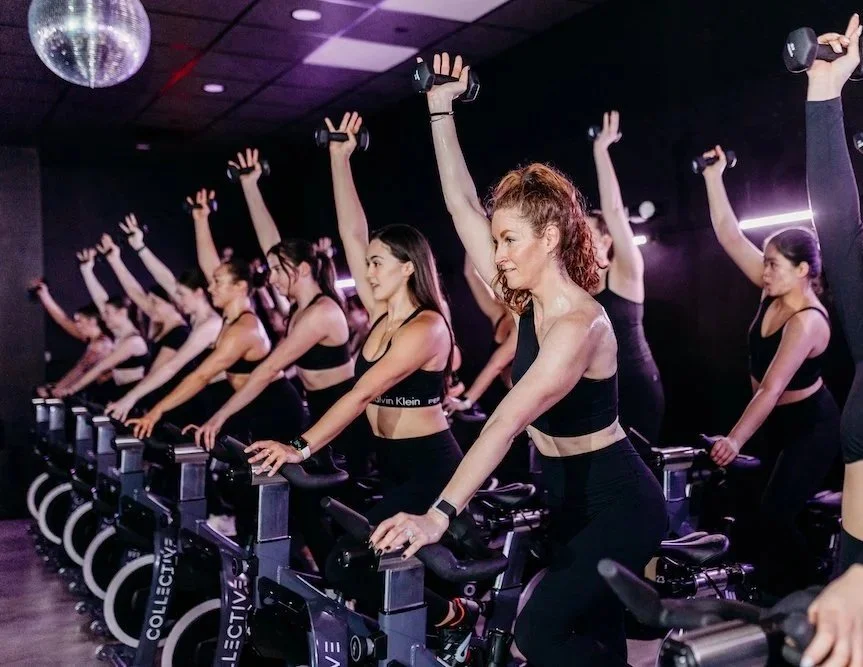
Most cycling classes stop at the lower body and core. At The Collective Studios, the ride includes something most people don’t expect the first time they come to class: a dedicated upper body segment using dumbbells, built directly into the class while your heart rate is still elevated.
The weights come out mid-class, and the pedaling stops. What follows is a structured sequence of upper body work—shoulders, biceps, triceps, and upper back—performed while you’re still seated on the bike and still warm from the ride. The movements are deliberate and instructor-guided, designed to complement the work you’ve already done rather than feel like a separate workout tacked on at the end.
The reason this works as well as it does comes down to timing. Strength training at an elevated heart rate is a genuinely effective combination—your muscles are warm, your circulation is up, and your body is already primed to work. What might feel like a modest set of shoulder presses in a traditional gym setting feels meaningfully different when your system is already running hot from 20 minutes on the bike.
The result is a class that covers ground most single-format workouts don’t. By the time the dumbbells go back down and you return to the ride, you’ve moved through your lower body, challenged your core, and addressed your upper body in one continuous session. Nothing is left untouched, which is exactly what makes it a full-body workout in the truest sense of the phrase—not just in theory, but in practice.
Key Takeaways
- Most cycling classes stop at the lower body and core. This one doesn't. At Collective Studios, a dedicated dumbbell segment is built directly into the ride — not tacked on at the end.
- Timing is what makes it effective. Strength training at an elevated heart rate hits differently. Your muscles are warm, your circulation is up, and your body is already primed to work.
- The result is a genuinely full-body session. By the time the weights go down, you've moved through your lower body, challenged your core, and addressed your upper body in one continuous class.
The Cardiovascular and Mental Benefits
The physical work is only part of what makes indoor cycling worth showing up for consistently.
From a cardiovascular standpoint, cycling is one of the most effective low-impact formats available. A well-programmed class moves through different heart rate zones, pushing into high intensity during sprints and climbs, then pulling back during recovery intervals before building again. That pattern of effort and recovery is what makes the cardiovascular adaptation so effective over time. Your heart gets stronger, your endurance builds, and your body gets more efficient at managing intensity, all without the wear on your joints that higher-impact formats carry.
But the thing that keeps most people coming back isn’t the cardiovascular data. It’s how the class feels. There’s something specific about a dark room, a strong playlist, and a room full of people moving through something hard together that makes the effort feel different than it would alone. The music sets the pace, the instructor holds the energy, and somewhere around the third climb, you stop thinking about anything outside of that room. For a lot of people, that hour becomes the clearest their head feels all day.
The stress-relief benefits are real and well-documented—intense physical effort is one of the most effective ways to metabolize stress hormones, and the group setting amplifies the mood lift that follows. Most people walk out of a cycling class feeling noticeably lighter than when they walked in. Not just physically tired, but genuinely reset (which is the whole point of showing up in the first place).
Key Takeaways
- Indoor cycling is one of the most effective low-impact cardio formats available. The pattern of effort and recovery across heart rate zones is what drives cardiovascular adaptation and builds endurance over time.
- The mental benefits are just as real as the physical ones. Intense effort metabolizes stress, and the group setting amplifies the mood lift that follows.
- Most people walk out feeling genuinely reset. Not just physically tired — mentally clearer, lighter, and noticeably different from when they walked in.
Indoor Cycling Is More Than a Cardio Class
Indoor cycling earns the full-body label in a way that most cardio formats don’t even attempt. By the time you’ve moved through the lower body work, held your posture through the core demands, pushed into the upper body segment, and let the cardiovascular effort do what it does to your stress levels and your mood, you’ve covered more ground in one class than most workouts manage in two.
Most people don’t expect to love indoor cycling as much as they do. Then they book it again before they’ve even left the parking lot.
Frequently Asked Questions
Does indoor cycling work your full body?
Yes — a well-programmed indoor cycling class engages far more than your legs.
Your core is activated continuously throughout the ride to maintain stable posture, and at Collective Studios, class includes a dedicated upper body segment using dumbbells mid-ride while your heart rate is still elevated. By the time class ends, you've worked your lower body, challenged your core, and addressed your upper body in one continuous session.
What muscles does indoor cycling work?
Indoor cycling primarily targets the quads, hamstrings, glutes, and calves — but the muscle engagement shifts depending on how the class is programmed.
Seated sprints challenge fast-twitch muscle fibers and cardiovascular endurance, while standing climbs at higher resistance build muscular endurance in the glutes and hamstrings. Your core works throughout to stabilize your posture, and your shoulders, biceps, triceps, and upper back are addressed during the dumbbell segment.
Is indoor cycling good for cardiovascular fitness?
Yes — it's one of the most effective low-impact cardio formats available.
A well-programmed class moves through different heart rate zones, pushing into high intensity during sprints and climbs before pulling back in recovery intervals. That pattern of effort and recovery is what drives cardiovascular adaptation over time, strengthening your heart and building endurance without the joint stress that higher-impact formats carry.
Is indoor cycling low-impact?
Yes. Because your feet remain supported on the pedals throughout the entire class, there's no repetitive ground impact.
You can push your cardiovascular system and work your muscles hard while keeping your knees and hips out of it — which makes it a strong option for people managing joint sensitivities or looking for an intense workout that doesn't take a toll on their body over time.
What are the mental benefits of indoor cycling?
Significant. Intense physical effort is one of the most effective ways to metabolize stress, and the group setting amplifies the mood lift that follows.
The combination of a strong playlist, an energizing instructor, and a room full of people moving through something hard together creates an experience that's difficult to replicate on your own. Most people walk out feeling genuinely reset — not just physically tired, but mentally clearer than when they walked in.