
What Muscles Does Lagree Work?
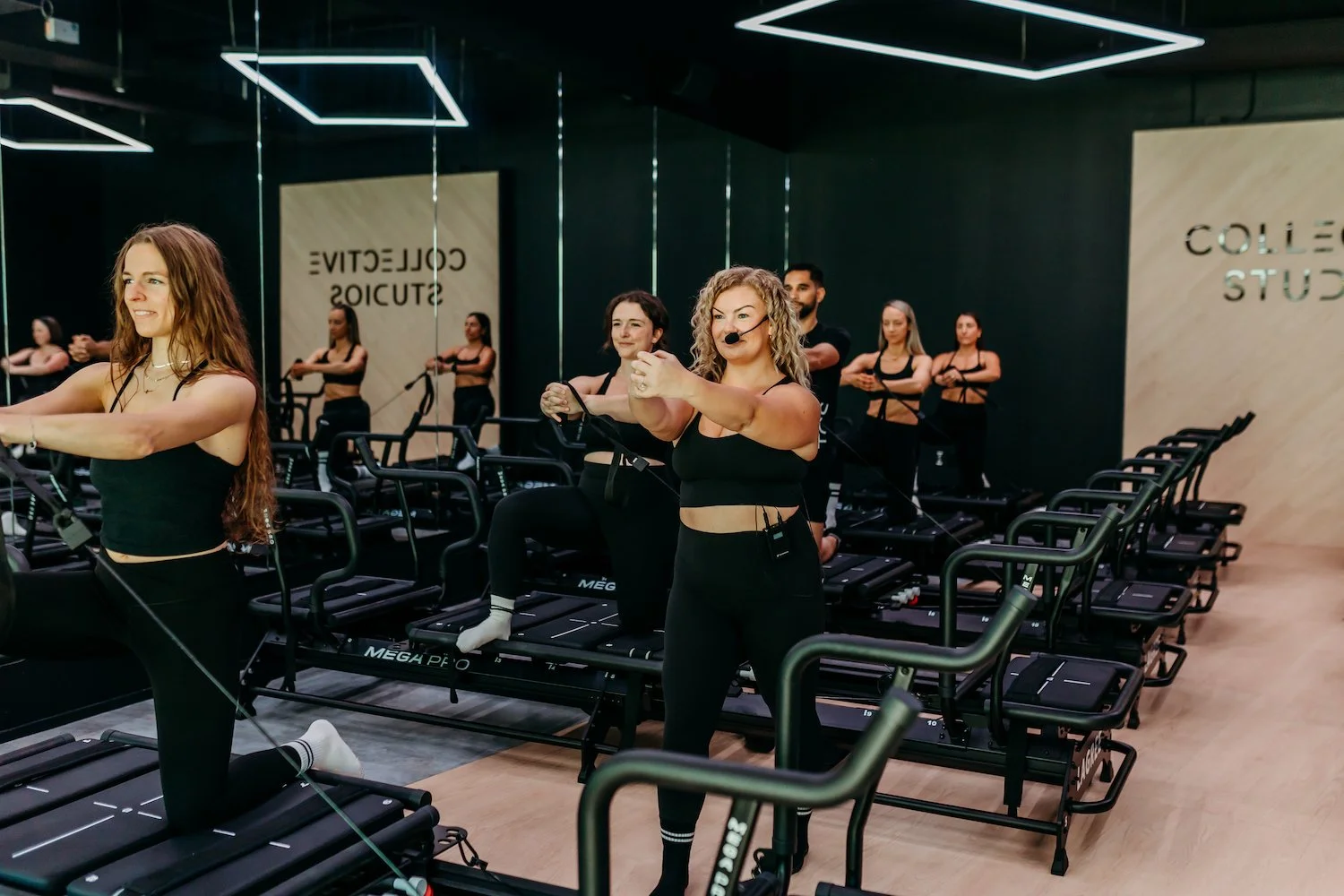
Curious about Lagree and how it compares to other resistance-training methods? This blog helps you understand what’s actually happening to your muscles during class—which muscles are being recruited, why they fatigue the way they do, and why the soreness shows up in places you didn’t expect.
Lagree has a reputation for being one of the most complete workouts available—and that’s not just clever marketing. The Lagree method is built around principles that force the entire body to engage simultaneously rather than in sequence, which means there’s no coasting, no muscle group sitting out, and no movement that doesn’t demand something from you. Understanding what muscles Lagree works also helps explain why the results feel different from anything else people have tried.
What You'll Learn
- Why the Lagree Method recruits muscle the way it does
- What muscle groups are worked during a class
- What makes that muscle recruitment unusually effective
Whether you’re considering your first class or you’ve been coming for months and want to understand what’s actually happening, this is the breakdown.
Table of Contents
How Lagree Works
Lagree is a full-body training method performed on a machine called the Megaformer, which is a spring-based platform with a moving carriage, adjustable cables, and multiple anchor points that allow for an enormous range of exercises. While sharing similarities with the Pilates reformer, the Megaformer was developed by Sebastien Lagree with a specific goal: create a workout that delivers the muscular conditioning of strength training, the cardiovascular demand of interval training, and the low-impact quality of Pilates simultaneously, in a single session.
The method is built on four principles that directly shape how your muscles respond:
Slow tempo
Time under tension
Constant instability
Zero momentum
Every movement is performed deliberately—typically five seconds in each direction—which eliminates the ability to use speed or inertia to get through a rep. The muscles have to do all of the work, for the full duration, with nowhere to hide.
The sustained demand is what makes Lagree particularly effective at recruiting slow-twitch muscle fibers—the deep, stabilizing fibers responsible for posture, endurance, and joint support. Most conventional workouts don’t fatigue these fibers efficiently because they rely on heavier loads or faster movement patterns. Lagree targets them directly, which is a significant part of why the muscular fatigue feels so different, and why it shows up in muscle groups people don’t typically feel in other formats.
If you want a deeper dive into the method itself, our breakdown of the Lagree method covers everything you need to know before your first class.
Full-Body Breakdown: The Muscles Lagree Works
Lagree doesn’t program around muscle groups the way a traditional strength workout does. There’s no chest day, no leg day, no isolated bicep curl that lets everything else switch off. Every movement on the Megaformer asks multiple muscle groups to work at once—some as primary movers, others as stabilizers—which is why a single class touches the entire body. Here’s what’s actually being recruited, and where.
Core
The core is never off in a Lagree class—not even when the exercise is targeting something else entirely. Because every movement happens on the Megaformer’s unstable carriage, the deep stabilizing muscles of the trunk are continuously engaged just to keep the body in position.
We’re not talking about the superficial abdominal muscles you might feel during a crunch. Lagree targets the transverse abdominis—the deepest layer of the abdominal wall—along with the obliques, the multifidus along the spine, and the pelvic floor. These are the muscles responsible for spinal stability, postural control, and the kind of functional core strength that actually transfers to how your body feels and moves outside the studio. Most people don’t access these muscles meaningfully in conventional training. In Lagree, they’re working from the moment the carriage starts moving.
Glutes and Hip Flexors
The glutes are among the most worked muscle groups in a Lagree class, and most people feel them within the first few exercises. The method hits all three heads—gluteus maximus, medius, and minimus—through a range of carriage-based movements that keep the muscles under tension for far longer than a standard squat or lunge pattern would.
The gluteus medius in particular—the smaller muscle on the outer hip responsible for stability and alignment—gets significant attention in Lagree. It’s chronically underworked in most people and directly connected to knee health, hip alignment, and lower back function. The hip flexors work alongside the glutes as both primary movers and stabilizers, depending on the exercise, creating a balance of anterior and posterior demand that’s difficult to replicate elsewhere.
Hamstrings and Quadriceps
Both muscle groups are recruited heavily in Lagree’s lower body sequences, and often simultaneously, which is part of what makes the fatigue feel so complete. The spring resistance on the Megaformer creates demand in both directions of movement, meaning the hamstrings are working eccentrically—lengthening under load—as well as concentrically.
Eccentric loading is where a significant portion of strength and muscle development occurs, and it’s built into Lagree’s movement patterns rather than something you have to add deliberately.
The quadriceps are engaged through deep, sustained positions that keep the muscles under tension for extended periods. Combined with the slow tempo, this produces a level of muscular fatigue in the legs that most people don’t experience from conventional lower-body training.
Inner Thighs and Outer Hips
The adductors and abductors—the inner thigh and outer hip muscles—are consistently targeted in Lagree and consistently underworked in most other training formats. They rarely get deliberate attention in conventional gym programming, which means many people carry significant weakness in these areas without knowing it.
In Lagree, the positioning and transitions on the Megaformer bring these muscles into almost every lower-body sequence. The adductors stabilize and drive movement from the inner thigh, while the abductors—particularly the gluteus medius—control the outer hip and knee alignment. Strengthening both is directly connected to knee stability, hip health, and overall lower-body balance. People who come to Lagree with chronic hip or knee discomfort often notice improvement here after consistent sessions.
Back and Posterior Chain
The posterior chain—the network of muscles running along the back of the body from the base of the skull to the heels—is engaged throughout a Lagree class as both a stabilizer and a primary mover. The erector spinae run alongside the spine and work continuously to maintain posture during carriage movements. The trapezius and rhomboids are recruited in pulling and rowing sequences, and the entire back line activates during plank-based exercises where the body has to resist the instability of the moving carriage.
One of the most commonly reported outcomes of consistent Lagree practice is improved posture, and the posterior chain work is a significant reason why. Strengthening the muscles that support the spine and hold the shoulders in alignment creates postural changes that show up in daily life, not just in the studio.
Arms and Shoulders
The arms and shoulders are recruited in every upper body sequence and as stabilizers throughout lower body and core work. The biceps, triceps, and deltoids are engaged in pulling, pushing, and holding patterns that the Megaformer’s cable system makes unusually versatile. The rotator cuff muscles—often neglected in conventional training and frequently the source of shoulder issues—are worked as stabilizers across a wide range of movements.
The arm and shoulder work in Lagree isn’t isolated the way it would be in a traditional upper body session, but it’s consistent. Most people notice definition and endurance improvements in the arms and shoulders with regular practice, even though those muscles are rarely the primary focus of any given exercise.
Key Takeaway: In a Lagree class, there’s no such thing as a rest position. Even when one muscle group is the focus, the rest of the body is working to maintain stability—which is exactly how a 45-minute session is able to deliver full-body results.
Why Slow-Twitch Muscle Fibers Matter
Most people have heard of muscle fibers without giving them much thought. But understanding the difference between the two main types—and which one Lagree specifically targets—goes a long way toward explaining why the method produces results that feel distinct from anything else.
The human body has two primary muscle fiber types. Fast-twitch fibers generate power and speed quickly but fatigue just as fast—they’re what you’re using in a sprint, a heavy lift, or a plyometric jump.
Slow-twitch fibers work differently. They generate less force but are highly resistant to fatigue, which makes them the fibers responsible for endurance, postural stability, and sustained muscular effort. They’re also the fibers that support joint health, spinal alignment, and the kind of deep muscular strength that holds the body together during everyday movement.
The problem is that slow-twitch fibers are genuinely difficult to exhaust through conventional training. Heavy resistance work recruits fast-twitch fibers preferentially. High-impact cardio burns through fast-twitch energy systems. Even many group fitness formats—despite feeling demanding—don’t create the sustained, controlled tension required to fully fatigue the slow-twitch fiber population.
But Lagree does. The slow tempo, the extended time under tension, and the elimination of momentum all work together to force slow-twitch fibers to keep firing long past the point where conventional training would have let them off the hook. That’s the burn people describe feeling deep in the muscle rather than on the surface.
It’s also why the fatigue accumulates the way it does. By the end of a set, the muscle isn’t just tired; it’s been working at capacity for longer than it’s used to.
Slow-twitch fiber development has significant functional implications. Working your slow-twitch muscle fibers effectively can:
Improve posture
Support joint stability
Build functional strength
Create a muscular foundation that supports your other fitness modalities
Lagree isn’t necessarily a replacement for other training, but it does nicely fill gaps that other training tends to leave. This also connects directly to why Lagree qualifies as high-intensity training despite being low-impact.
Frequently Asked Questions
Is Lagree good for building muscle?
Yes. Lagree builds muscle effectively through sustained time under tension and slow-twitch fiber recruitment — two mechanisms that conventional training often underutilizes. The method won't produce the same results as heavy powerlifting, but it develops functional muscle with significant endurance capacity. Most people notice meaningful changes in muscle tone and definition with consistent practice over six to eight weeks.
Does Lagree work your abs?
Lagree works the entire core — not just the surface abdominal muscles but the deep stabilizers, including the transverse abdominis, obliques, and multifidus. Because every movement happens on the Megaformer's unstable carriage, the core is engaged continuously throughout class, even during exercises that primarily target the lower body or arms. It's one of the most thorough core workouts available in a group fitness format.
How long does it take to see results from Lagree?
Most people begin to notice changes in muscular endurance and how their body feels within two to four weeks of consistent practice. Visible changes in strength and definition typically become more apparent around the six- to eight-week mark. Results depend on frequency — three sessions per week tends to produce noticeable progress faster than one or two — as well as sleep, nutrition, and overall recovery habits.
How does Lagree compare to traditional Pilates for muscle engagement?
Both methods emphasize controlled movement and core stability, but they differ significantly in intensity and equipment. Lagree uses the Megaformer's spring resistance and moving carriage to create sustained time under tension across the full body simultaneously. Traditional Pilates tends to work muscle groups more sequentially and at lower intensity. For people seeking a more cardiovascular, full-body challenge, Lagree typically produces a higher level of muscular fatigue per session.
Can beginners do Lagree?
Yes, Lagree is accessible to beginners, though the first few classes have a learning curve. The movements require coordination and body awareness that takes time to develop, and the Megaformer can feel unfamiliar at first. Most studios offer introductory classes or recommend newcomers take their first few sessions at a slower pace while they find their footing. At The Collective Studios, our instructors cue different options for spring loads and form modifications to ensure classes are accessible for all levels.
45 Minutes. Every Muscle.
Lagree works the entire body—not in sequence, not in isolation, but all at once, for the full duration of class. The core stabilizes while the glutes drive. The hamstrings load eccentrically while the shoulders hold position. The slow-twitch fibers are pushed past the point where most workouts let them rest. That’s what makes 45 minutes on the Megaformer produce results that feel different from anything else.